
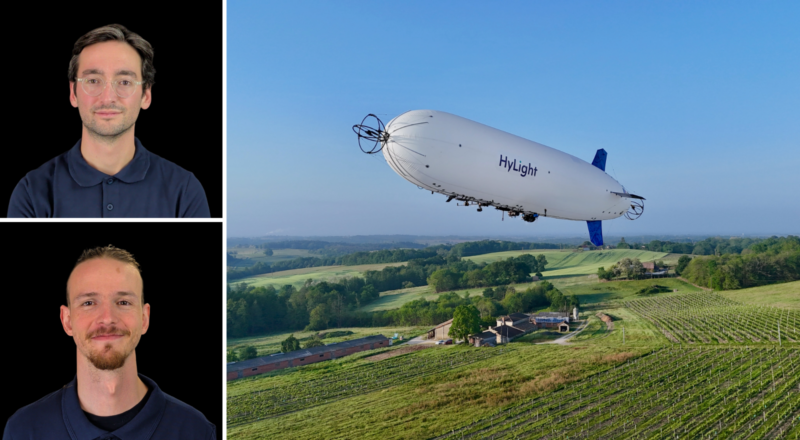
Founded in 2022, HyLight is developing a new generation of infrastructure inspection and intelligence services. Using HyLighter, its autonomous, hydrogen-powered airship drone, the company collects high-precision data over hundreds of kilometres and transforms it into actionable insights using artificial intelligence.
Designed, industrialised and operated in France, this technology is already being deployed for major European energy and transport infrastructure operators. Last month, HyLight announced a €13 million funding round, prompting Gate.31 to sit down with the company’s representatives for an interview.

From Inspection to Infrastructure Intelligence
Beyond aerial inspection, HyLight aims to turn the data it collects into decision-support tools. Its technology can automatically detect and geolocate more than 50 types of defects, as well as vegetation-related risks near power networks.
Thousands of images captured during flights are converted into structured, accurate and actionable information for maintenance teams. The goal is to make it easier to identify anomalies, better prioritise interventions and improve the monitoring of infrastructure over long distances.
As inspection campaigns become more frequent, the data collected helps build a digital representation of the infrastructure and areas being monitored, with the potential to evolve into a true digital twin. By combining different data sources, this representation opens up opportunities for applications in other sectors, such as insurance, agriculture and land management – Martin Bocken, Co-founder and CEO of HyLight.

Scaling from 4 to 15 HyLighters operating simultaneously by 2027
HyLight has now entered its industrialisation phase. Its new production facility in Brétigny-sur-Orge, south of Paris, is operational, and the company is continuing to bring the manufacturing of strategic components in-house, with the aim of operating up to 15 HyLighters simultaneously by 2027.
Interview with Mischa Masson, Head of Flight Test at HyLight
What technical parameters will evolve in the next generations of your airships?
Development of future versions is underway, with several objectives: increasing flight speed, improving endurance and boosting payload capacity, while optimising the collection and processing of data delivered to clients.
For example, we are working on a new patented propulsion technology that should enable us to fly twice as fast while halving energy consumption. This will allow us to reach higher speeds, operate in more challenging weather conditions and cover longer distances using the same amount of energy.
Can the HyLighter fly in all weather conditions?
Like any aircraft, the HyLighter has certain limitations. Its operating conditions are similar to those of a drone, with current wind-gust resistance of up to 40 km/h. Our long-term target is 50 to 60 km/h.
One of our key strengths lies in our onboard intelligence and control algorithms, which can analyse wind conditions and adapt the aircraft’s flight path accordingly.
Furthermore, HyLight does more than just collect data and deliver inspection reports. We also handle mission planning and flight optimisation!

Can your technology already be deployed in other European countries?
The HyLighter has already flown in France and Italy. We also have the necessary authorisations to operate in other European countries, so we could certainly fly in Belgium!
What role does artificial intelligence play in your development today?
For HyLight, as for many companies, AI plays an important role in data processing. We train our models to recognise different types of defects in order to automate their detection as much as possible.
To avoid overwhelming clients with raw data, AI helps us select the most relevant information. Finally, onboard intelligence also helps detect certain obstacles during flight.
As a Belgian engineer, what does it mean to you to be involved in such an unusual and ambitious project as HyLight?
I really enjoy working on start-up projects, even though they require a substantial personal commitment. This project gives us the opportunity to imagine and bring to life entirely new aeronautical solutions.
Our only real limitation when it comes to development is ourselves! That is incredibly motivating.
[ Find out more about the HyLighter airship drone ]
Measuring 12 metres in length, the HyLighter combines the endurance of a long-range aircraft with the precision of an inspection platform. Powered by hydrogen, it operates with zero direct emissions and a very low noise footprint. It can achieve an endurance of up to ten hours, with a target range of 350 kilometres.
Capable of carrying up to 10 kg of sensors, including LiDAR systems, cameras and methane detectors, it delivers high-precision data, with images reaching a resolution of 1 mm per pixel at an altitude of 25 metres and LiDAR point-cloud densities exceeding 1,000 points per square metre.
Authorised by the French Civil Aviation Authority (DGAC) and the European Union Aviation Safety Agency (EASA), the HyLighter can conduct beyond visual line of sight (BVLOS) flights over critical infrastructure in rural, peri-urban and urban environments.
