
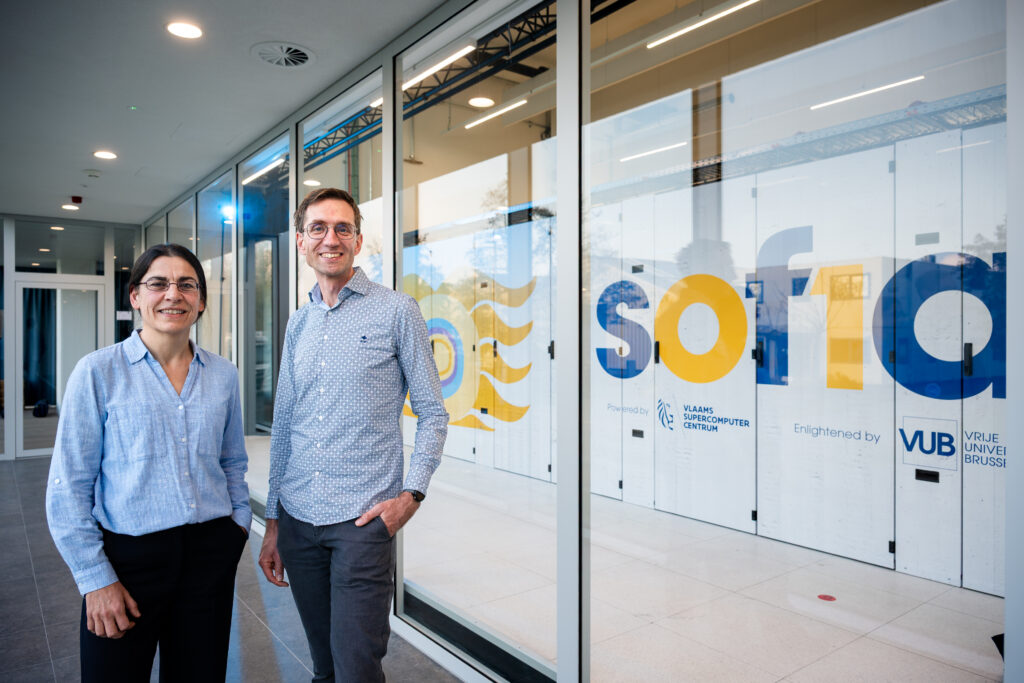
At the end of 2025, VUB inaugurated new Flemish Tier-1 supercomputer ‘Sofia’
“The Tier-1 supercomputer has been designed to meet the growing demand for AI in research and innovation, but researchers using applications beyond AI can, of course, also make use of Sofia,” said Ward Poelmans, Head of the Scientific Data & Compute (SDC) department within VUB’s ICT Department.
The new supercomputer is housed in the Nexus data center on VUB’s Green Energy Park campus.
“The supercomputer will be used to develop models that can lead to meaningful innovations. This can range from simulations of waterways and weather models to predict, for example, when another extreme rainfall event might occur, to creating AI models that can predict defects in steel cables in time. We have already seen examples of companies that, thanks to this technology, can run their simulations up to ten times faster.” declared Karin Voets, CIO of the VUB.
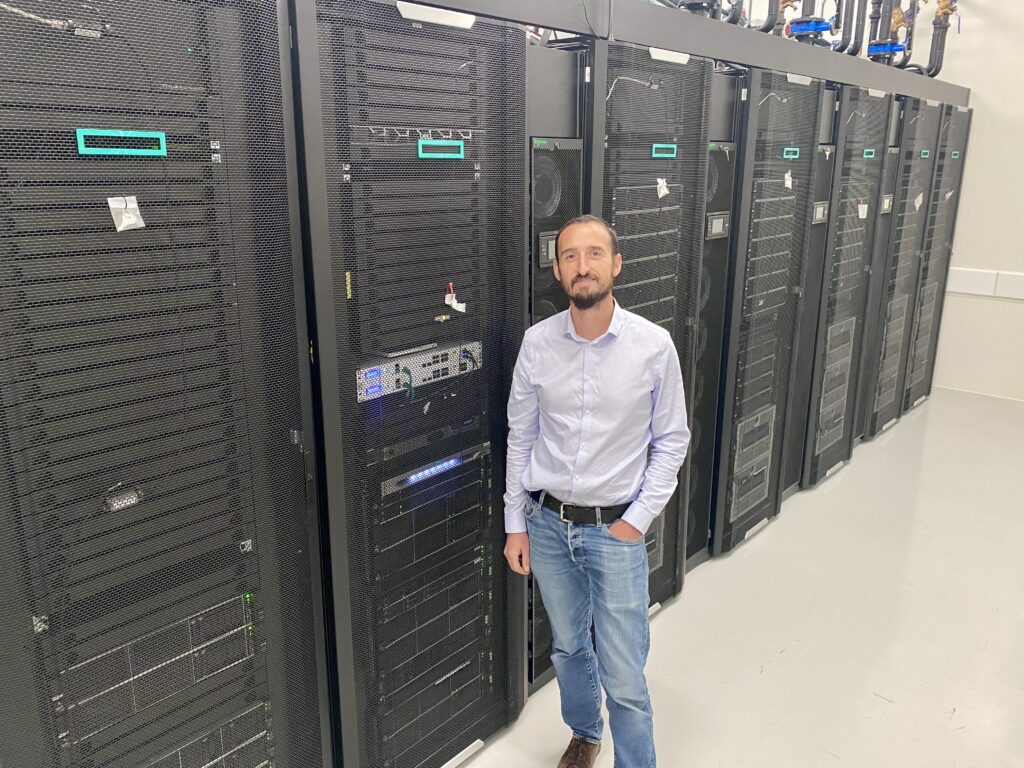
On the occasion of Sofia’s inauguration, Gate.31 examined Belgium’s HPC infrastructures and their role in the rise of AI Antennas and Factories. Meeting with Benoît Dompierre, coordinator of the EuroCC Belgium program.
Can we outline the landscape of high-performance computing facilities in Belgium?
High-performance computing (HPC) infrastructures or supercomputers are traditionally classified into categories called “Tiers” which correspond to computing power. These Tier levels are complementary. In Belgium, publicly funded HPC infrastructures span a spectrum from Tier-2, with a regional scope, to Tier-0, of international scale.
In Wallonia, the CÉCI (Centre des Équipements de Calcul Intensif) manages Tier-2 machines, whose use is reserved for Walloon academic actors. The research center Cenaero operates the Tier-1 supercomputer Lucia, which is accessible not only to Walloon academics for their own research but also to external users through a paid access model.
In Flanders, the structure is broadly similar, but the entire HPC ecosystem is managed and coordinated by the VSC (Vlaams Supercomputer Centrum).
At the international level, Belgium contributes to the funding of the European Tier-0 supercomputer LUMI, hosted in Finland. This participation grants Belgian stakeholders privileged access to this very high-capacity infrastructure. In addition, Belgian users can leverage resources made available through the EuroHPC initiative as well as HPC infrastructures operated by private entities, notably through cloud computing solutions.

« Thanks to its multi-level structure and diverse access modalities, Belgium’s HPC ecosystem can address a wide range of scientific, industrial, and technological needs, from fundamental research to advanced innovation applications » – Benoît Dompierre.
What are the main application areas and user profiles of high-performance computing?
It is not straightforward to publish general statistics, as usage strongly depends on the specific machine. Tier-0 infrastructures are typically used for advanced research and are predominantly accessed by academic users, although the rise of generative AI may shift this balance.
Private cloud-type HPC are generally oriented toward private users due to their economic model.
More detailed data are available for certain specific infrastructures. For example, the supercomputer Lucia, operated by the research center Cenaero, has published usage statistics covering its first year of operation, from mid-2023 to mid-2024. During this period, 6% of computing resources were used by private companies. The main scientific domains represented included physics, chemistry, computer science, mechanical engineering, and Earth and environmental sciences.

Can we briefly present two use cases?
In the private sector, a notable example is the collaboration between Safran and Cenaero on the optimization of aeronautical compressors. This project combines HPC with AI to solve complex physical equations. Recent advances in AI have enhanced these models, enabling simulations that are both more accurate and faster. This use case demonstrates the potential of AI to improve energy efficiency, both in the design process and in the final performance of aeronautical products.
In the public sector, there are numerous applications. A prominent example is weather forecasting. The Royal Meteorological Institute of Belgium (IRM) increasingly combines classical HPC computations with AI to produce more accurate and longer-term forecasts. Other major applications include healthcare, such as the discovery of new therapeutic molecules or the simulation of pandemic spread within populations.
How is access to supercomputers organized, and based on what prioritization criteria?
The specific rules depend on each infrastructure. In general, academic, and public research can access HPC resources either free of charge or at a very low cost, through a selection process that evaluates the relevance of the request and requires a commitment to publish the results of the work.
For economic or industrial activities, access is usually fee-based, with conditions varying by infrastructure. The cost of using public HPC infrastructures is generally very affordable, primarily covering operational expenses. Resource prioritization mechanisms are defined at the funding stage of each infrastructure, in the form of quantitative allocation targets. For example, a target allocation might reserve approximately 10% of computing capacity for industrial use, with the remaining 90% dedicated to other activities, including academic and public research. The supercomputer then manages the scheduling and prioritization of jobs to achieve these allocation targets.
The energy consumption of these facilities is often criticized. What measures are being taken to reduce the energy usage of these infrastructures?
This is a timely and relevant question. Just as there is a Top500 list of the most powerful supercomputers, there is also a Green500 ranking for the most energy-efficient machines. Several measures contribute to reducing energy consumption.
The first concerns the power usage of compute processors. At equivalent computational performance, next-generation processors are increasingly energy-efficient.
A second lever involves cooling. Ten or twenty years ago, nearly two-thirds of the energy in an HPC center was consumed by cooling. Today, this figure has typically been reduced to around 20%. Additional initiatives further decrease energy demand. For example, the LUMI supercomputer relies entirely on renewable energy, and its location in Finland allows it to contribute significantly to local district heating networks.
Beyond infrastructure measures, efficiency criteria can also be incorporated into resource allocation processes. Some HPC infrastructures require users to demonstrate the efficiency of their code or workflows before granting access to significant computing resources. This encourages more sustainable and responsible computing practices.
With the rise of AI, what role will supercomputers be expected to play?
AI factories are expected to play a major role in Europe and, consequently, in Belgium. Each AI Factory is centered around infrastructure specifically designed for AI. Belgium is involved through a national node called BE-AIFA, which aims to support the growth of AI within the Belgian ecosystem.
Belgium will not develop a dedicated AI infrastructure of its own but will leverage the infrastructures of the LUMI and JUPITER AI Factories. Belgian stakeholders will therefore have privileged access to these resources. At the same time, existing HPC infrastructures in Belgium will continue to support AI-related needs, as they already do today.
« BE-AIFA represents a unique opportunity to massively accelerate innovation around AI for Belgian actors! » – Benoît Dompierre.
Discover the new Sofia supercomputer at VUB : Press Release Sofia
