
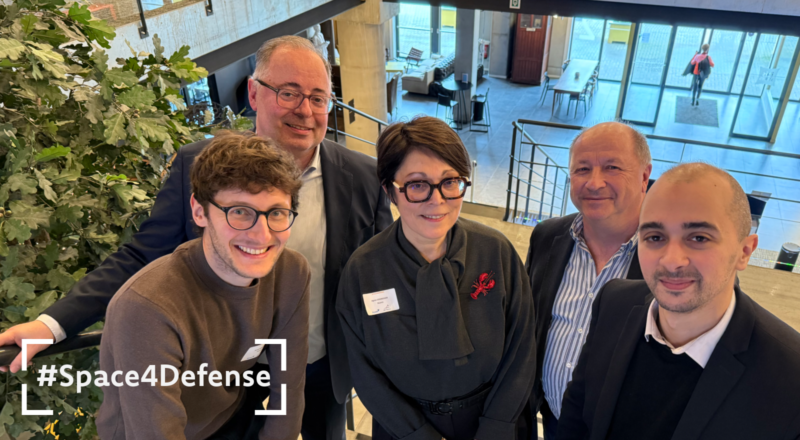
On the occasion of a recent workshop organized by Skywin dedicated to the “Space4Defense” theme – a new dimension of the technological and strategic defense roadmap in the Walloon Region (Belgium) – Gate.31 spoke with Dr. Bilal Outirba, Senior Researcher at the École polytechnique de Bruxelles & Project Liaison Officer for Space4ReLaunch.
The interview provides an overview of the space-related capabilities that can be mobilized to address national priorities as well as European and NATO defense dynamics.

Could you provide an overview of the existing capabilities in Wallonia in the field of space applied to defense?
Wallonia, and by extension the Fédération Wallonie-Bruxelles, benefits from a space ecosystem firmly anchored within European Space Agency (ESA). It is composed of the country’s five French-speaking universities, ten research centers – including federal institutions already collaborating with Walloon stakeholders – and around thirty companies, ranging from start-ups to internationally recognized large industrial groups.
The technologies developed by these stakeholders are capable of covering the entire satellite value chain, from the space segment to the ground segment and end users. At a time when the issue of European strategic autonomy in access to space is more relevant than ever, it is equally important to highlight Wallonia’s contributions to the development and production of European launchers, which deserve continued support.
All of this is backed by a number of infrastructures, including environmental facilities capable of simulating the harsh operating conditions specific to space; manufacturing laboratories ranging from micro-machining to additive manufacturing for large-scale components; large-scale testing facilities for propulsion equipment; and, of course, the IDELUX cybersecurity center, which features a crisis simulator and a quantum cryptography laboratory.
To what extent do these capabilities meet the current and future needs of Belgian Defense?
The Belgian Defense has recently unveiled its strategic roadmap at the federal level. The priorities focus on Earth observation, space situational awareness, and the development of technologies in VLEO (Very Low Earth Orbit), meaning at altitudes below 400 km.
These capabilities would notably make it possible to develop high-resolution Earth observation sensors, particularly infrared sensors equipped with auxiliary systems (thermal management, vibration control, mechanical stabilization) designed to enhance their stability and accuracy, as well as antenna networks capable of scanning the entire RF spectrum.
Likewise, opportunities exist in the field of onboard data processing algorithms enhanced by artificial intelligence, which will need to enable near real-time exploitation. Data fusion is also a major area of development. With a view to deploying its own Earth observation constellation, contributions are possible in the mass production and standardization of satellite structures for constellation architectures.
Finally, the deployment of satellites in VLEO requires in-depth study of the orbital environment, suitable propulsion systems, and optimized satellite platforms – areas that R&D stakeholders are fully capable of investigating.

How would you position the Walloon ecosystem with regard to the major domains identified by NATO?
The Walloon ecosystem is relatively well positioned across the full range of operational domains defined by NATO.
Its expertise in hyperspectral sensors – particularly infrared – and optical components for surveillance naturally places it within ISR (Intelligence, Surveillance and Reconnaissance) and SSA (Space Situational Awareness). Current trends are moving toward the miniaturization of these components, improving their resolution, and the gradual integration of artificial intelligence into data processing, data fusion, and enhanced space situational awareness – all of which directly support ISR and SSA objectives.
Research is also actively exploring the development of RF components, antennas, and antenna arrays for beamforming applications, as well as the securing of communications through quantum key distribution (QKD). These capabilities position the ecosystem within the SATCOM domain.
Furthermore, the development of payloads, the refinement of numerous Earth environment and oceanography models, and recognized expertise in space weather – covering both instrumentation and predictive modeling – represent strong assets for establishing credible positioning in the METOC (Meteorology and Oceanography) domain.
However, the Walloon space ecosystem is somewhat less advanced in PNT (Positioning, Navigation and Timing) and SEW (Shared Early Warning). Nevertheless, initiatives do exist around the development of more resilient and more accurate PNT systems, as well as software solutions enabling the early detection of ballistic missile launches.
What concrete opportunities do you identify for increased participation in international programs, particularly those led by NATO, the European Defence Agency, or the European Defence Fund?
The expertise of the Walloon space ecosystem in the design and manufacturing of satellite components (sometimes niche) and launchers should legitimately foster the emergence of international partnerships – especially since the Belgian Defence outlook is itself aligned with NATO priorities and the initiatives of the European Defence Fund – Dr. Bilal Outirba.
On the NATO side, the most tangible opportunities lie in acting as a provider of operational capabilities, particularly in the development of sensors; automated data processing and fusion; cyber-resilience of space systems; manufacturing of satellite platforms and equipment; and leveraging existing or emerging industrial capacities to develop constellations. The list is long and far from exhaustive.
Finally, at the local level, space for defense can serve as a concrete economic lever, strengthening the competitiveness of Walloon companies through improved return on investment, progress along the industrial scale, and the creation of highly skilled jobs.
—
Text & Visual ©️Gate.31.
